
GNC ≠ Trans
What a shaved head – or an outfit -- can’t tell you.

Stop! Look closely at the woman below.
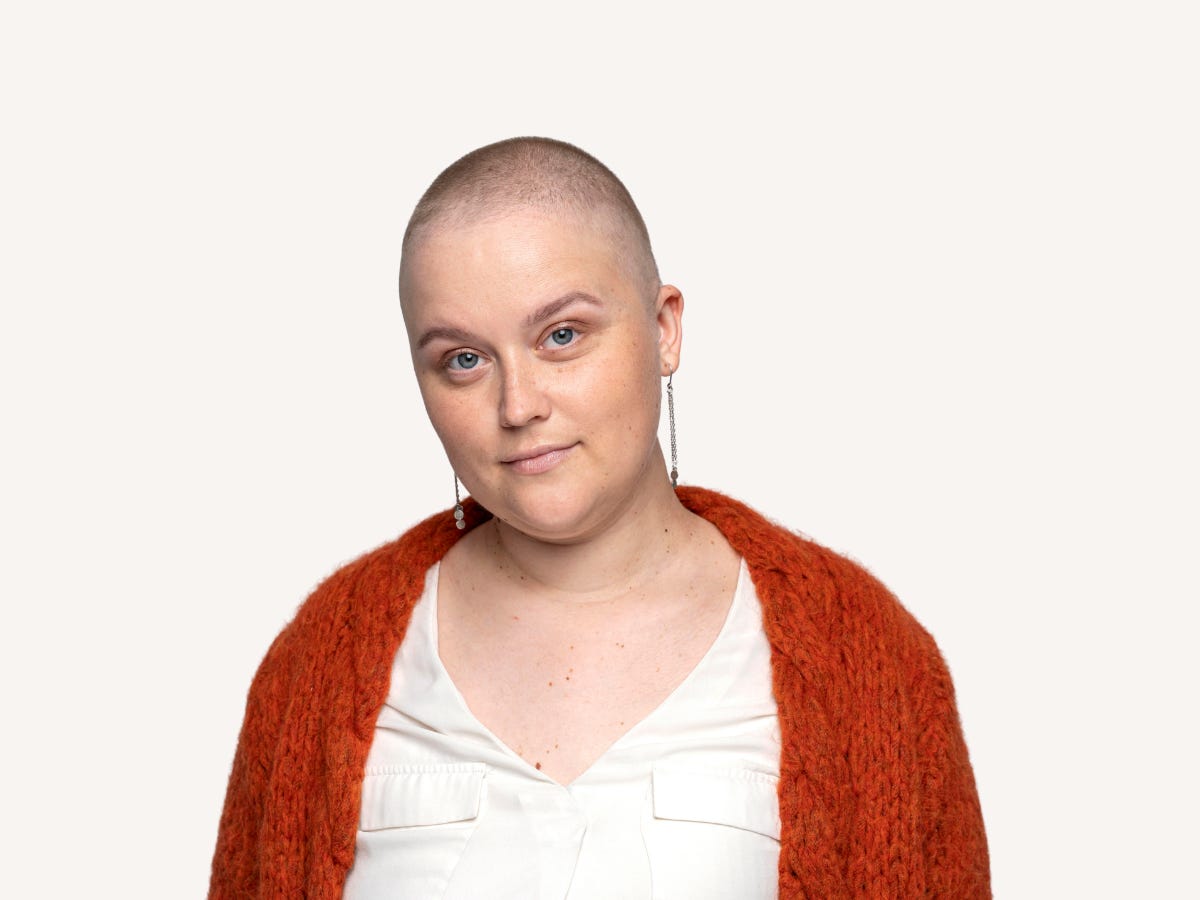
What assumptions did you just make about this woman?
Maybe you thought: Cancer.
Maybe you thought: Alopecia.
Maybe you thought: White Nationalist.
Maybe you thought: Daring style! You go, Girl.
What you can’t know from the image alone is why her head is shaved or what having no hair means to her. The photograph provides you with her presentation, her external expression. It tells you nothing about her identity.
Now imagine someone approaching this woman with a warm smile and a recommendation for a good oncologist. Or imagine someone approaching her and sliding a diversity-and-inclusion pamphlet across the table, then backing slowly away.
Well-intentioned actions.
But potentially very wrong.
And potentially very offensive.
What Happened
I’ve been reaching out to potential Substack collaborators, including writers whose work demonstrates genuine familiarity with and support for the LGBTQ+ community. In my emails, I described one of my primary topics as “dressing my GNC daughter.” Three of them responded with resources and suggestions oriented toward a trans teenager.
I’ve never used the word trans to describe Rowan -- not in my outreach emails or in this newsletter. If Rowan were trans, my husband and I would support her completely. It simply isn’t how she identifies. She is a girl who prefers masculine-leaning clothing.
I want to be clear: I found my correspondents’ responses interesting, not upsetting. Their responses were kind and intended as helpful. And yet: masculine presentation was read as trans by people dedicated to advocating and/or creating for the LGBTQ+ community. People who were sincere in their attempts to affirm and support my work and/or my child. This seeming contradiction—that the mislabeling was happening by the very people who authentically detest mislabeling in other circumstances—is what makes their reactions worth examining.
A Note on Terms
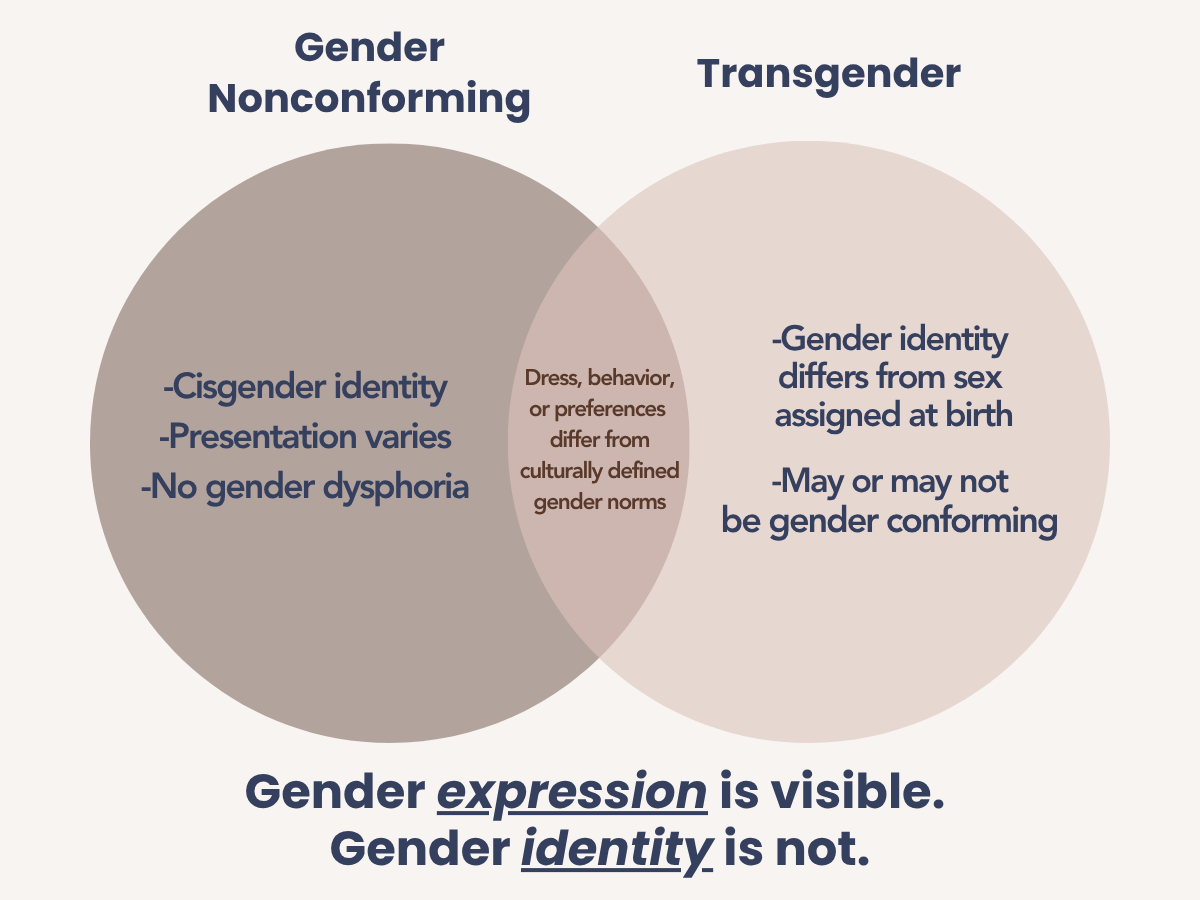
Gender nonconforming (GNC) describes someone whose gender expression — through presentation, behavior, or other means — doesn’t conform to their culture’s gender norms. A GNC person may or may not be trans. They may not identify as LGBTQ+ at all. Transgender describes someone who identifies as a gender other than the one they were assigned at birth. A trans person may present in a conventionally gender-conforming way, or not. (Nonbinary Wiki Glossary)
The overlap between these two categories is real but partial. Some GNC people are trans. Many are not. Many trans people are entirely gender-conforming in their presentation. The Venn diagram has an overlap zone, but it is not a circle inside a circle.
Why it Happens: Take 1
The cognitive shortcut.
The brain is a pattern-matching machine, and gender is one of the patterns it learned earliest. In 1981, psychologist Sandra Bem described what she called gender schema theory: children develop mental frameworks for categorizing behaviors, appearances, and traits as masculine or feminine, and those frameworks shape how they process everything they encounter afterward. The schemas run quietly in the background, organizing incoming information before you’ve had a chance to consciously evaluate it. Adults, it turns out, never really outgrow this process.
When a presentation doesn’t fit the expected schema, the brain doesn’t pause to say, "I don’t have a category for this." It reaches for the nearest available one. For most of modern history, the nearest available category for a girl who dressed like a boy was tomboy. A generation later, it became lesbian. Now, for people who are deeply embedded in LGBTQ+-affirming communities and highly attuned to gender identity, the nearest available category is often trans.
They aren’t consciously defaulting to this term. They are applying an existing schema and integrating partially updated cultural content. The mechanism is identical to what it’s always been. Only the category at the end of the chain has changed.
Bem herself called for a society that would stop “projecting gender into situations irrelevant to genitalia.” What she probably didn’t anticipate was that this projection would eventually run in more directions than the original binary — and that the most well-intentioned observers would be among those doing it.
Why it Happens: Take 2
GNC as a placeholder.
There’s a second possibility, and I want to handle it carefully.
The term gender nonconforming is sometimes used by parents who believe their child may be trans or questioning, but who aren’t ready — or don’t yet have the language — to say so outright. In that context, GNC functions as a temporary term: a way of signaling that something is in motion without naming it directly. I understand that impulse, and I’m not criticizing it. Parents navigate this topic at their own pace, based on what they know about their child.
But I want to gently push back on the use of GNC as a substitute for trans when a child or teenager has confidently and consistently named their own identity. We should believe people when they tell us who they are. If a young person says they are trans, gender nonconforming is not a more careful or protective word for the same thing. It’s a different thing. Using it in place of trans — even with protective intentions — is its own form of not listening.
The people who responded to my outreach may have read GNC and heard exactly that holding pattern — a signal that something larger was in motion that I wasn’t ready to name yet. I’m not suggesting that reading was unreasonable. I’m suggesting it was wrong and that the gap between the two is worth contemplating.
To Clarify
Expression is not identity, and collapsing the two — even with good intentions — erases a distinction that matters to the people living on one side of it. A GNC girl who is not trans deserves to have that identity taken seriously, not treated as a preliminary draft of a different one.
Second -- and this matters -- the error runs in both directions. Assuming a masculine-presenting girl is trans is the same cognitive shortcut as dismissing her as “just a tomboy” and assuming she’ll grow out of it. Both errors read the outside and skip the inside. The solution is identical in either case: ask, listen, follow the kid’s lead. Let her tell you who she is.

The Gap
I went looking for empirical work on this specific phenomenon — how GNC individuals are misread as trans within affirming communities — and came up largely empty. As it turns out, this is a known gap. A 2017 review of gender schema theory research noted that queer and gender-nonconforming populations are “specifically underrepresented” in the literature, flagging as a future direction the question of how gender-nonconforming youth “might subvert gender roles” within and across communities (Starr & Zurbriggen, 2017). Research on how updated cultural schemas produce new categorical errors — within affirming spaces, among people trying to get it right — hasn’t been done yet.
Which means what I’m describing is, for now, mostly anecdotal. But the mechanism Bem described is well-documented, and the cultural shift in available categories is observable. The specific application — GNC misread as trans by affirming communities — is a gap in the literature waiting for someone to study it.
Have you experienced well-intentioned mislabeling? Maybe you’re a vegetarian (like me) and have been called vegan. Maybe you’re an introvert who gets called shy. Or maybe you are a woman who shaves her head as a style choice, and a stranger once asked, “Who is your oncologist?”
Works cited
Bem, S. L. (1981). Gender schema theory: A cognitive account of sex typing. Psychological Review, 88(4), 354–364. https://doi.org/10.1037/0033-295X.88.4.354
Starr, C. R., & Zurbriggen, E. L. (2017). Sandra Bem’s gender schema theory after 34 years: A review of its reach and impact. Sex Roles, 76(9–10), 566–578. https://doi.org/10.1007/s11199-016-0591-4
A Very Limited Glossary
Gender nonconforming (GNC): Describes someone whose gender expression — through presentation, behavior, or other means — doesn’t conform to their culture’s gender norms. A GNC person may or may not be trans and may or may not identify as LGBTQ+. (Nonbinary Wiki)
Transgender: An umbrella term for people who identify as a gender other than the one assigned at birth. Includes binary trans identities (trans women, trans men) and often nonbinary identities, though not all nonbinary people identify as trans. (Nonbinary Wiki)
Gender expression: The way a person communicates their gender through clothing, behavior, speech, and other external means. A feminine person isn’t necessarily female; a masculine person isn’t necessarily male. Gender expression is visible. Gender identity is internal. (Nonbinary Wiki)
Gender identity: A person’s internal sense of their own gender. Not the same as gender expression. Not everyone whose appearance or behavior is gender-nonconforming will identify as transgender. (APA)
For more terms: Nonbinary Wiki Glossary
This is so fascinating! It seems the solution is so simple yet often so hard to do- pause and listen. I love the mix of research and reflection.